Fireboats boost port safety while witnessing history
by Gillian Wee
PHOTO: Sarah Burge
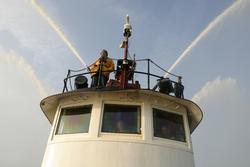
Fireboat co-owner John Doswell takes in the view of New York Harbor from atop the pilot room as Captain Bob Lenney and co-owner Huntley Gill peer from inside.
As most of Manhattan sleeps, the John J. Harvey comes alive. First, her engines grind awake, then, the 130-foot, 74-year-old vessel eases down the Hudson River. "Watch yourselves," shouts a member of her crew as the fireboat approaches the Statue of Liberty.
Eight brass nozzles spout arcs of water high over the river, first drizzling the Harvey with a fine mist, then soaking the two dozen crew and passengers standing on deck who are only partly protected by their foul-weather suits.
A towering ship nearly 10 times the Harvey's length approaches from the sea. The Harvey is participating in history: helping welcome the world's biggest and newest transatlantic liner, the Queen Mary 2, on her maiden voyage into New York Harbor.
While they serve a ceremonial role as greeters of great ships, fireboats also play a critical role in maintaining safety in a port city with 578 miles of waterfront.
They have firefighting capacities equivalent to the combined power of 20 water-pumping fire trucks. New York had come close to forgetting that, letting its fireboat fleet shrink over the decades. But the Harvey helped remind city officials of the value of fireboats on the morning of Sept. 11, 2001.
The Harvey had for years been a floating museum, but that day and the next her volunteer crew kept the vessel's powerful pumps running around the clock, helping other fireboats keep water flowing to firefighters ashore long after all the onshore hydrants had failed in the disaster.
The Fire Department of New York, for the first time in more than 12 years, is planning to add a new 130-foot fireboat to its shrunken firefighting fleet of five with a $15 million grant from federal domestic security funds. To boost its port safety, the Los Angeles Fire Department also recently replaced four fireboats out of its current fleet of five, buying one of the world's most powerful craft, which can pump up to 38,000 gallons a minute compared with the Harvey's 20,000 gallons.
Fireboats have been used in large waterfront cities since the mid-1800s, when trade flourished and ports and piers buzzed with activity. The vessels were popular in large European cities like London before spreading to large American cities. In recent years, however, even as shipping traffic grew in New York Harbor, the city's firefighting fleet, costly to staff and maintain, did not keep up.
Sept. 11 showed just how vital such vessels can be, said Al Trojanowicz, the Harvey's unofficial biographer and a former dispatcher for the FDNY.
"The city water mains are usually adequate, but in 9/11, the ship was indispensable," he said. "You don't use them much, but when you need them, nothing else will do."
When built in 1931, the Harvey was the largest and most powerful fireboat in the world and was added to a New York City fleet of a dozen boats. It was bound for the scrap yard in 1999, but was rescued by 10 investors, all of whom were lovers of nautical history, and they slowly rehabilitated the aged craft and turned it into a floating museum. Since then, others have invested in the effort or volunteered time to scrub or paint or scrape.
On most days, it's berthed on the rebuilt piers along the West Side of Manhattan, but on a recent April morning, the Harvey waited for the Queen Mary 2 with other tugboats, fireboats and ferries. It blared its horns, reprising its role of 1936, when it greeted the original Queen Mary on its first voyage to New York.
As the Harvey slipped through the fog, the crew played a game of boat-spotting, identifying the other fireboats dotting the busy harbor. The boats blasted air-horn greetings to each other and each spouted water in celebration of the event. One boat, the John D. McKean, shot jets of water dyed red and blue. The camaraderie on the Harvey attracts volunteers to help maintain the ship and foster awareness of its history. The co-owners of the vessel bring youth groups and other visitors on harbor and river tours, steaming up the Hudson River as far as Troy. Only three of the Harvey's five engines work now, and the owners hope to raise half a million dollars to repair the other two.
Like seasoned sailors, the crew stood at the rail watching the giant liner loom.
As another boat's air horn blared, Larre Yee, an artist, cupped his hands and said, "They're talking to us."
Yee encountered the Harvey when he worked on Pier 40, along the waterfront.
"I'd see the boat out to and fro from the port, it put a smile on my face," he said. "When I heard about the fundraising, I decided to help."
As the strengthening sun cut through the dawn fog, a rainbow materialized in the curtains of mist thrown by the Harvey's pumps.
Thorner Harris, who works in public health, was snared by the Harvey when he saw the vessel in 2000 on the East River. "I met her that day and the relationship hasn't ended, it just got stronger and stronger," Harris said.