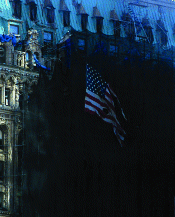
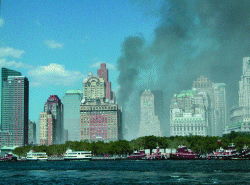
A tattered U.S. flag flies from a building near Ground Zero. Always a symbol of freedom and hope, the flag has taken on renewed meaning since the attacks.
Calls for assistance answered
The Coast Guard's New York Command Center and the Vessel Traffic
Center are located on Staten Island. By the time the second aircraft hit
the WTC, the Coast Guard was in a crisis mode, knowing people had to
get off of Manhattan Island, and that would require a massive evacuation.
McGovern met with Lt. Mike Day, the Coast Guard's chief of the
waterways oversight branch in New York, upon his arrival. Both agreed
that the Staten Island vessel traffic center was good, but with all the small
craft expected, they knew they had to actually be at the Manhattan
waterfront to establish control. "We put together a quick plan but
anticipated we would be shooting from the hip once we got there, so I
placed a call to the Sandy Hook Pilot station asking for the pilot boat New
York, designated as Pilot No.1, and anything else we had floating,
McGovern said.
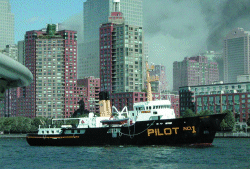
The pilot boat New York was chosen as the floating command center
because of its high maneuverability, its ability to stay on station a long
time and its large wheelhouse with the necessary communications
equipment. The immediate quick plan was for McGovern and another Sandy Hook pilot to direct most of the
traffic by radio from the pilot boat New York. Also onboard, and in overall command, was Day. He also
directed the Coast Guard contingent. This included a communications team that was in direct contact with
the Staten Island Center, Coast Guard vessels and personnel on other launches to maintain security in the
upper harbor. McGovern estimated the pilot boat Maritime Command Center (MCC) was in place and fully
operational off Manhattan by about 1045.
When the Coast Guard called for all assistance, some tugboats were already at the scene with others
making ready to assist. The tugboat Franklin Reinauer, under Capt. Ken Peterson and followed by three
other Reinauer tugboats, arrived at the Battery seawall around 1130. Peterson said he radioed the MCC
aboard the pilot boat New York for permission to go to the Battery seawall to take on passengers. Seeing 10
other tugboats standing off the Battery, he radioed them to come to the seawall. "People started running for
the boats and I got off and started directing traffic," Peterson said. "The first day, we had 27 tugboats on the
Battery wall and five at Pier 11." Tugboats from Moran, McAllister, Turracamo, Reinauer, Penn Maritime,
Skaugen PetroTrans, Weeks Marine and other companies responded and continued to arrive during the
afternoon. "It quickly became a collaborative effort with Andy McGovern, Ken Peterson and me determining
how to best employ all the resources," Day said.
Fire-fighting efforts at Ground Zero relied heavily on water supplied by two city fireboats and a welcome
addition, the ex-New York City fireboat John J. Harvey. Privately purchased by outbidding the scrap dealers
in 1999, the boat had been repaired since then and docked at Hudson River Pier 63. On the morning of Sept.
11, the owners and two volunteer crewmembers got John J. Harvey underway and began assisting in the
evacuation. "We took probably 200 people up to Pier 40 past the WTC, so they could walk home," said
Chase B. Wells, the fireboat's principal owner. The crew then responded to a call to assist the other fireboats
pumping water from the river to Ground Zero. Many of the fire command had been killed, and "there was a
real vacuum of power," Wells said. But other fire officers stepped in to direct operations. "It was
unbelievable," he said.
Vessels pull up to the Battery seawall and take on survivors of the attack.
Keeping the vessels and survivors moving
Among the maritime community's members, no potential
problem seems to have been overlooked as individuals came
forward to use their skills and company assets. Kurt
Erlandson, owner of Randive Inc., Perth Amboy, N.J.,
anticipated the possibility of lines fouling propellers with so
many boats operating in close quarters. One Randive dive
crew had been working in the anchorage south of the
Verrazano Narrows Bridge when the first plane hit the WTC.
"I pulled them out of there and dispatched them to assist the
evacuation. Then the rest of the crew and I arrived in New
York on Randive's boat with a complete diving spread about
1130, after we got clearance to go to the Battery," said
Erlandson. Working off of Randive's boat and one of the
Miller's Launch boats, the divers averaged six jobs a day clearing cables and hawsers from the response
boats and tugboats. In their free time, they assisted coordinating the supply operations. "It was just another
layer of a safety net that just happened," Miller said. "But for the vessel operators, it was so valuable knowing
a commercial diver was there."
People helping people
The survivors of the WTC attack boarding the boats were mostly the walking wounded. Some people had
cuts, torn clothing and were covered with dust. "There was no chaotic panic. It was somber. They were kind
of dumbfounded about the whole situation," said one maritime rescuer. Vessel crews provided coffee, water,
soft drinks and helped their passengers clean up.
"It was horrible. We saw people jumping out of the windows," Imperatore said. "Then you just got busy
helping people, evacuating people off the seawall, from the piers, wherever we could get a boat in and there
were people waiting."
The Sandy Hook Pilots' station boat New York went into service as a floating command center and directed relief vessels moving people and supplies to and from Manhattan after the terrorist attacks.
During the initial evacuation period, the objective was to just
evacuate people from Manhattan. "People were coming to
the boats wanting to go anyplace," Miller said. Not atypical
was the story of a SeaStreak passenger who just wanted to
get on the boat out of New York and when he arrived in New
Jersey's Atlantic Highlands he asked where he was. "He
didn't have a clue, but he knew he wanted to get out of
Manhattan."
The evacuation operation soon became more focused.
"Quick-thinking people like Kenny Peterson starting to slap
signs on the tugboats indicating where they were headed Ñ
Brooklyn, Queens, Weehawken, Jersey City and Staten
Island," Miller said. Jim Sweeney, vice president of
operations for Penn Maritime, aboard the tug Penn II, noted,
"It was amazing how they directed people to the escape
routes from Manhattan."
Many of the WTC survivors, unable to reach the Battery area, walked uptown. All ground transportation,
including New York City subways and the trains and buses to suburbs in New York, New Jersey and
Connecticut, had been shut down for security reasons. On the midtown area's West Side, two marine
avenues quickly opened. NY Waterway evacuated many people from their midtown locations at the foot of
West 38th Street to their Hoboken, N.J., terminal, adjacent to a major commuter New Jersey Transit rail
station. "They were able to catch a train home. They were very grateful," Imperatore said