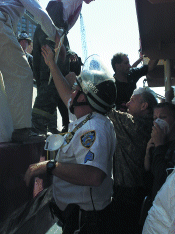
Police and crew help survivors board a vessel at Battery Park. The U.S. Coast Guard estimates that more than a million people were evacuated by maritime operations.
Staten Island Ferries brought in emergency workers from Staten Island
and evacuated civilians. From the Battery to West 42nd Street people
lined up along the river wherever a boat could reach them and take them
to New Jersey. Spirit Cruises' three dinner boats picked up people at the
Chelsea Piers and carried them across the river to Weehawken. NY
Waterway's midtown waterfront terminal had long lines. Throughout the
long day, everyone was orderly and restrained.
At the docks of New York Circle Line Sightseeing Yachts Inc. at West
42nd Street, management and crews had a clear view of the terrible
events unfolding downriver at the WTC and cancelled the regular
sightseeing cruises. "By 1015 people started coming to the pier," said
Peter Cavrell, vice president of sales and marketing at New York Circle
Line Sightseeing Yachts. On its own initiative, the company began a
shuttle service using the three largest Circle Line Sightseeing Yachts tour
boats with 600-passenger capacities, making continuous trips across the
Hudson River to Weehawken. As the day turned warmer, and because
there was not much shade, some employees ran hoses along the long
lines of people waiting to board boats and supplied them with wetted
paper towels. "We also sent a few staffers into midtown to tell any people
walking north that we were offering free service to New Jersey," Cavrell said. By mid-afternoon of Day One,
the lines translated to a three-hour wait to board the boats. That day, few people among the maritime
community's rescue workers kept track of time, and Cavrell's reply to a question about when they ceased
evacuation operations was typical: "We kept going into the night and I don't really know when we stopped."
There were some small incidents that lifted rescuers' spirits, such as the man jumping on the tugboat Nancy
Moran at the seawall to escape Manhattan with his six-year-old son. Gregory J. McGinty, senior vice
president at Moran Towing, said the story that reached him was that one of the tug's crew "took this kid
through the tugboat to see the engine room and everything. The kid drew a picture for the captain to thank
him. In what was probably the most horrific experience for a young child, all he could talk about was the
tugboat ride."
Many survivors of the WTC and the immediate area considered themselves lucky to get out of Manhattan and
reach their homes over the next 18 hours. It was due to the professionalism of the captains, crews and
owners of the vessels that immediately put themselves on the line and at risk to help.
Kathleen Moran and Margaret Moran despite the smoke from the burning World Trade Center buildings. At times, the smoke was so thick that it
reduced visibility for the vessels to nearly zero.
Doing whatever had to be done
In the chaos of Day One, the goal for many injured was reaching medical
help. Saint Vincent's Hospital, just to the north of the WTC, received
many injured and dying emergency and WTC workers. Triage centers
were set up at the Battery, across the Hudson River at Liberty State Park
in Jersey City, and Staten Island. With up to 50,000 people working in and
visiting the WTC complex on an average working day and recalling the
large numbers of people evacuated from the city after the 1993 bombing of
the WTC, many expected large numbers of injured people with burns,
broken bones, heart attacks and other injuries. NY Waterways had
several boats dedicated to carrying injured survivors to the triage center at
Liberty State Park during Day One and may have assisted up to 2,000
injured people requiring medical aid. Other boats also evacuated injured
victims across the Hudson River to Jersey City. With Manhattan streets
closed and numerous ambulances destroyed in the falling rubble of the
WTC buildings, the cross-Hudson water evacuation route was undoubtedly
the quickest route from south of the WTC to medical services, and it
saved many lives. At the Battery seawall, some of the larger tugboats
were kept there because their large open-back decks could provide space
for injured people on gurneys.
McGovern said at one point, the MCC heard rumors that "a couple of hundred wounded were expected at
34th Street. We ran some boats up there and stood by, but nobody ever showed up."
Unfortunately, it soon became apparent to the maritime rescue boats' crews that the evacuation would not
involve the large number of people, both walking and injured, first envisioned. Bostock had been on the
maritime scene after the 1993 WTC bombing. "We moved out a lot of people," he said. "Far fewer people
came off Pier 11 than in the previous incident. Obviously a lot just didn't make it out." Miller, who was on the
waterfront rescue scene from the beginning, also saw the inevitable and commented quietly: "Everybody was
ramped up for the wounded, the seriously injured, but that never really materialized. For the most part, if they
didn't walk out before the collapses, they didn't get out, and they are in that pile."
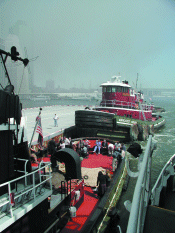
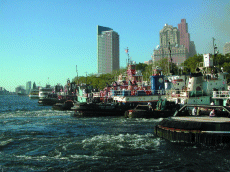
Tugs and other relief vessels pushed into the seawalls around Manhattan in order to get to survivors and put equipment ashore where it was needed most.
During Day One, the maritime community's evacuation vessels
took survivors off Manhattan and many of the return trips carried
fresh rescue workers. On one late-day return trip to Manhattan
by Fox Navigation's high-speed ferry Tataban under Tragert, a
number of medical and professional people were brought in from
Glen Cove. "They stood by until they were told they would not be
needed and then returned to Glen Cove close to midnight,"
Theofield recalled.
For the next few days, there was still the hope of recovering
survivors buried in the ruins and rubble and for recovering bodies.
The survival of the New York City Fire Department's Ladder
Company 8 and one civilian on a fourth-floor stairway of the
collapsed North Tower provided some encouragement. But the
reality was that there would be very few buried survivors found,
so when the need for more evacuations was over by Day Two,
McGinty said the Coast Guard asked Moran Towing to hold three tugs to transport bodies the next day to a
temporary morgue on Staten Island. "We were sensitive to the guys on our boats who had experienced their
own levels of stress," McGinty said. "We talked to them, laid out a plan and told them they didn't have to do
it if they didn't want to. They all said they would do whatever had to be done."